Roman Empire
Quo VadisIn Quo Vadis, the Roman Empire is more than a backdrop: it is the governing power whose military reach, legal claims, imperial commands, and management of the capital shape the characters’ lives. The novel’s broader historical frame presents its conflict with Christianity as a contest of moral ideas, while its scenes of frontier diplomacy, hostage custody, popular provision, and disaster show how imperial authority works in practice—and how vulnerable it becomes when Rome’s ordinary systems fail.
Imperial Reach and Frontier Affairs
The Empire’s reach is visible in its concern for a distant war among neighboring peoples. During conflict involving Vannius and his nephews, the Lygian forces’ numbers alarm Claudius, who directs the Danube legions to monitor events and prevent the fighting from disturbing Roman peace. The commander, Atelius Hister, requires the Lygians to promise not to cross the frontier; they agree and provide hostages, including the wife and daughter of their leader. The fighting nevertheless ends with the Lygians’ king dead and the hostages left in Roman custody. This episode presents imperial power as a combination of military oversight, frontier regulation, and the taking of guarantees from peoples beyond Rome’s immediate control.
The frontier also connects directly to Lygia’s personal history. After her mother dies, Hister sends the girl to Pomponius, governor of Germany. Following his return to Rome and triumph, Pomponius gives Lygia to his sister Pomponia Graecina, the wife of Aulus Plautius. The narrative states that hostages cannot be considered captives, a distinction that helps explain her transfer into a Roman household rather than continued detention as a prisoner of war. Yet the distinction does not give her control over her future: her status as a pledge remains available to the imperial government as a basis for claiming custody.
Law, Custody, and Imperial Command
That tension becomes explicit when Nero orders Aulus Plautius to surrender Lygia. The imperial messenger presents the command as a matter of guardianship: because Lygia is the daughter of a Lygian king and was given to Rome as a pledge, she should be under the protection of Caesar and the Senate. Aulus, a veteran accustomed to obeying orders, complies despite his visible distress. His response makes the practical force of imperial authority clear: personal affection and years of care do not outweigh the ruler’s claim.
Aulus then tells Lygia that she was raised as his and Pomponia’s child but is not their daughter, and that Caesar is taking her from their house. The distinction between household belonging and formal status changes the meaning of her home at the moment she is removed from it. In the same crisis, Pomponia urges Lygia to remain pure and to endure rather than take her own life; she contrasts the power of Caesar’s household with the greater authority of divine mercy and the hope of resurrection. Her counsel makes the imperial residence not merely a destination imposed by law but a moral danger against which faith must provide a different measure of authority.
The reach of Caesar’s command is reinforced by a letter from Marcus Vinicius to Aulus, which accepts what has happened as the will of Caesar. Later, when Lygia is imprisoned, guards tell Vinicius that they will not release her immediately because they fear responsibility; they might hand her over when the prison is filled and the prisoner lists become confused. The episode exposes the uneven operation of authority: imperial power has placed Lygia in custody, while those enforcing custody weigh their own exposure before acting. Petronius responds by preparing disguises and weapons and instructing Vinicius to offer the guards a vast payment to free her, turning private influence and money into an attempted counterweight to official control.
The Capital, Its People, and Imperial Favor
The Empire’s capital is portrayed as a dense, socially mixed city whose population depends in part on state distribution. Rome includes enslaved people and freedmen, visitors drawn by the prospect of fortune, religious attendants, traders, performers, and people who seek grain from storehouses on the Tiber each week. The account links the city’s immense scale and varied population to the emperor’s provision of food and amusement, while also showing how much urban life depends on those arrangements.
Petronius’s public standing illustrates the unstable relationship between popular approval and imperial violence. The crowds recognize him and value his generosity; his popularity also grows after he speaks against the sentence requiring the collective execution of Pedanius Secundus’s household slaves. He presents his intervention as a defense of Roman taste against a slaughter he considers barbaric, rather than as sympathy for the crowd. His judgment remains skeptical: he recalls that the same people had loved members of the imperial family who were later killed or exiled, and that the crowd applauded Nero after the executions. In this view, popular favor can turn quickly and offers no reliable protection from the power of the state.
Imperial display and public provision meet again in the preparations for Nero’s journey to Antium. The crowd gathers along the route, hears stories about distant lands and the emperor’s travels, and is told of a ship carrying enough wheat for two years, along with passengers, soldiers, and animals for the games. The anticipated spectacle and the promise of food help generate enthusiasm for Caesar. The scene shows how entertainment and provisioning can strengthen the appearance of imperial generosity, even as the Empire’s material resources are concentrated in displays and journeys organized around the ruler.
The Great Fire and the Limits of Rule
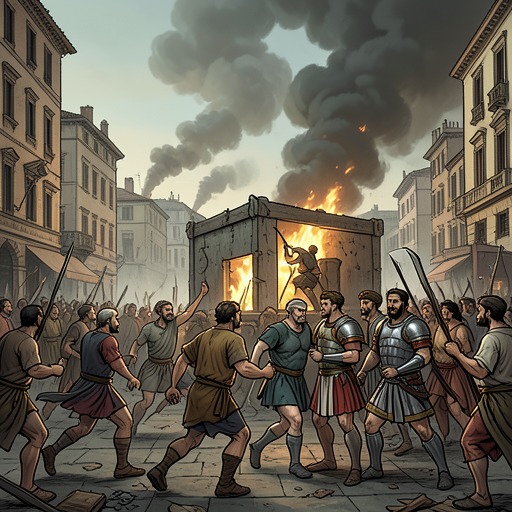
When the Great Fire devastates Rome, destruction becomes a crisis of supply and government as well as a catastrophe for the city. The stores of provisions burn, and hundreds of thousands of people are left without homes outside the walls. With public authority disrupted, the arrival of Tigellinus precedes orders to obtain supplies from Ostia. Bread and flour are brought in from there and from nearby towns, but the first delivery at the Emporium is seized by the crowd. People fight over loaves, supplies are trampled, and soldiers eventually use force to disperse the gathering. The episode makes the dependence of order on food immediate: relief reaches the city, but its distribution is not secure simply because the authorities have arranged transport.
Petronius later addresses the crowd with promises that Rome will be rebuilt, that gardens will be opened, and that distributions of wheat, wine, and olives will begin the next day. He also promises games and gifts. His words spread through the crowd and are answered by a unified demand for bread and circuses; he then asks the people to honor Caesar, who feeds and clothes them. The exchange turns emergency relief into public performance. Material aid is promised, but the promise is joined to entertainment and a demonstration of loyalty to the emperor.
Afterward, provisions arrive in abundance. Wheat is sold cheaply and given free to the indigent, while wine, olives, chestnuts, sheep, and cattle also reach the city. The immediate danger of famine is averted, but the disruption has not restored public order. Theft and violence continue amid temporary camps; people are abducted, conflicts occur where herds arrive from Campania, and bodies are left along the Tiber. The contrast between successful provisioning and continued insecurity shows that imperial supply measures can answer hunger without repairing the institutions and protections damaged by disaster.
Historical and Narrative Significance
The Roman Empire is presented through both its reach and its dependence on cooperation. It can monitor a frontier, require hostages, and remove Lygia from the home in which she was raised; in Rome, however, its authority must also contend with hungry crowds, uncertain distribution, and popular allegiance that can shift between indignation and applause. Legal language, imperial commands, military supervision, private influence, and public spectacle all appear as instruments through which power is exercised, but none erases the consequences of human vulnerability.
This political setting gives the novel’s moral conflict its historical scale. The introductory account describes Quo Vadis as depicting the opening scenes of a struggle between moral ideas and the Roman Empire, a conflict from which Christianity emerged as a leading force in history. In the episodes considered here, that larger contest is grounded in concrete pressures: the state’s claim over a hostage, the household’s inability to protect her, the crowd’s dependence on food, and the ruler’s use of provision and games to command public attention. The Empire is therefore both an immense structure of rule and a system whose authority is tested whenever its laws, promises, or material protections fail to meet the needs of those under it.